
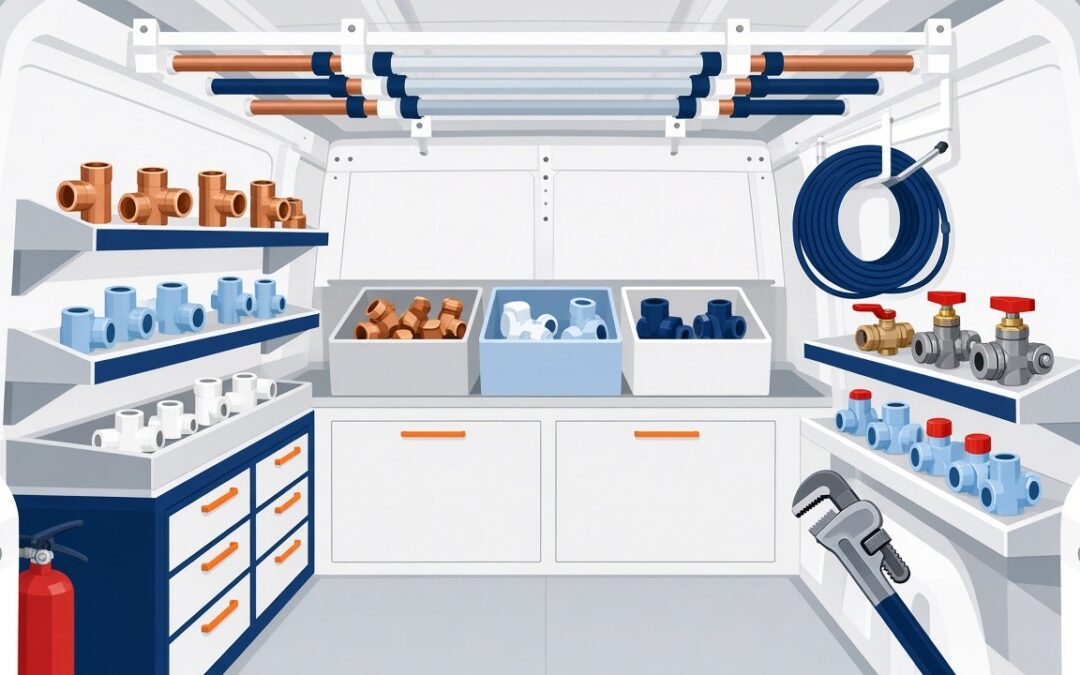
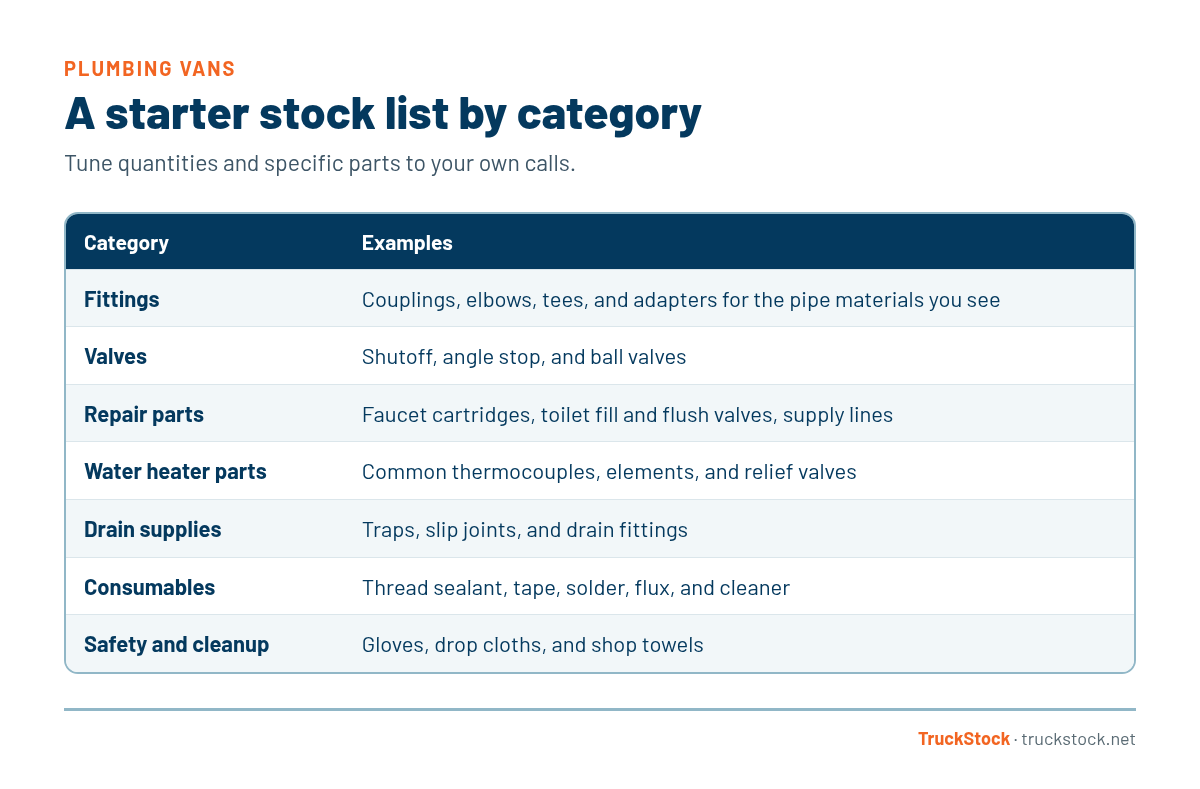
A plumbing service van should carry the fittings, valves, repair parts, drain supplies, and consumables that your most common calls use, plus a few must-carry items for jobs that can’t wait. Start from a category list like the one below, then tune quantities and specific parts to the work your company actually does.
There’s no single perfect list for every plumbing van, because a residential service company and a commercial one see different calls. But nearly every plumbing van carries the same categories, and having a starting list beats building one from memory. We wrote about seasonal stock for winter in what to carry for frozen and burst pipe calls. This post is the year-round baseline.
A Starter Stock List by Category
How to Tune the List to Your Calls
1. Start with your most common jobs
List the calls your techs run most often, like leaking faucets, running toilets, water heater issues, and slow drains. For each one, list the parts it usually needs. That’s the core of your van list.
2. Match your area’s pipe materials
The fittings you carry depend on what’s in the homes and buildings you serve. Copper, PEX, CPVC, and galvanized all show up in different areas and eras of construction. Carry what your techs actually run into.
3. Add must-carry items
Some parts are rarely used but stop a job cold if missing, like a shutoff valve or a specific repair coupling. Keep a small quantity of those even if usage is low.
4. Set max levels
For each part, set a max level that covers a normal stretch between restocks. Fast movers get higher maxes, slow movers lower. Here’s how to set min and max levels.
5. Review after a few months
Once you have usage history, look at what’s moving and what isn’t. Move slow parts to the stockroom and raise maxes on parts that run out. Our post on reducing dead stock covers the cleanup.
Why a Standard List Helps
When every plumbing van starts from the same list, techs can jump into any van and know where things are. Restocking is easier because the stockroom knows exactly what each van should carry. And when a part keeps running out, you fix it once on the list instead of van by van.
A standard list also makes onboarding easier. A new plumber gets a van that’s already stocked to the same list as everyone else, so the first few weeks are about learning your customers and your process, not hunting for parts.
A Quick Example
Picture a residential plumbing company that has been stocking vans by habit. The service manager pulls a few months of jobs, sorts them by type, and builds a list by category. Faucet cartridges and fill valves get higher max levels because they move every week. A couple of larger repair parts become must-carry with a max of one. Every van gets the same list, and after a few months, the manager trims parts nobody used and raises the maxes on parts that kept running out.
Common Mistakes
- Copying a generic list without tuning it to your calls.
- Carrying fittings for pipe materials your techs rarely see.
- Skipping must-carry items because usage is low.
- Letting each van drift to its own list.
- Never reviewing the list once it’s set.
How TruckStock Handles It
- Truck types with max levels. Create a plumbing van type with its parts list and max levels, and every van of that type follows it.
- Import from a template. Load a truck type’s parts and maxes from a CSV template instead of typing them in.
- Request limits. Techs see their on-hand and max for each part, so restock requests stay within the list.
- Usage reports. See which parts each van used over any date range to tune the list.
Key Takeaways
- Start from a category list, then tune it to your calls.
- Carry fittings for the pipe materials you actually see.
- Keep a few must-carry items even if they’re rarely used.
- Set max levels and use one standard list per van type.
- Review usage after a few months.
Frequently Asked Questions
What are the most important parts for a plumbing van?
The parts your most common calls use, plus a few must-carry items. For many residential companies, that includes fittings, shutoff valves, faucet and toilet repair parts, and drain supplies.
Should every plumbing van carry the same stock?
Vans doing the same kind of work should start from the same list. Install or commercial vans may need their own lists.
How do I decide quantities for each part?
Use your usage history and restock schedule. Carry enough to cover a normal stretch between restocks, with higher maxes for fast movers.
How often should I update a plumbing van stock list?
Review it every few months, and before seasons that change your call mix, like winter.
Want to set up a plumbing van stock list? Start a free TruckStock trial or contact our team.
Recent Comments