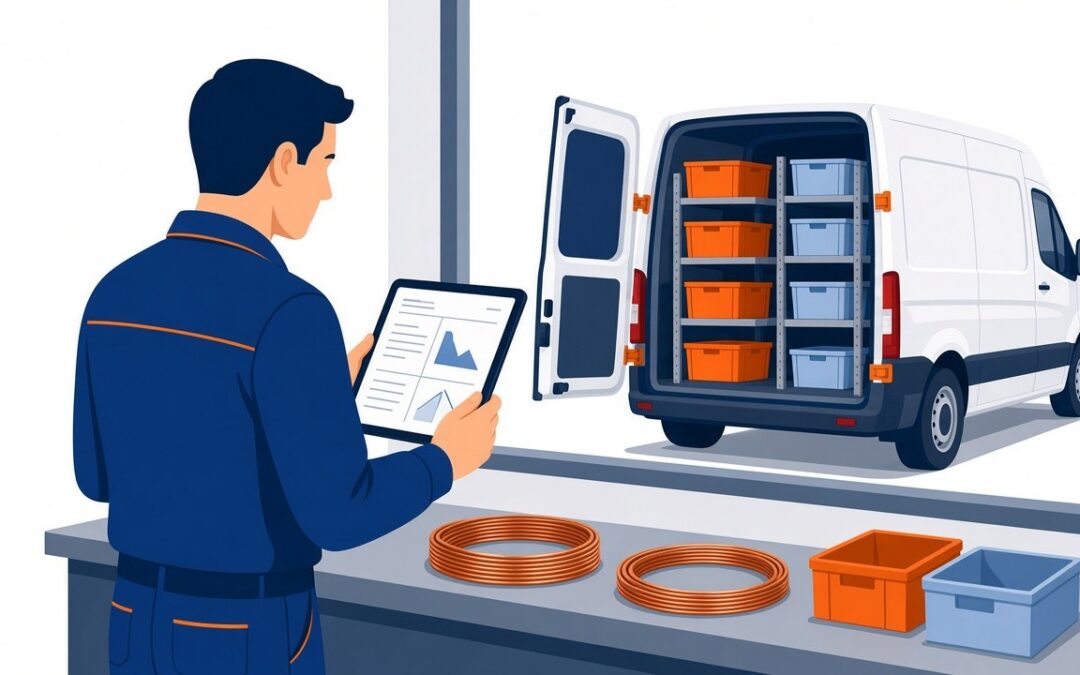
When parts prices go up, update the costs in your parts catalog first, then recheck max levels on your most expensive and slowest-moving parts so you are not tying up more cash on every truck. Buy ahead only on fast movers with a confirmed increase coming, and keep restocking trucks on your normal routine instead of hoarding.
Price increases are in the news again this fall. In its HVAC Price Increase List: October 2026 roundup, published October 7, ACHR News reported that many manufacturer increases for October fall around 3% to 6%, with Aeris Metals raising linesets an average of 12.9% and Robertshaw raising some affected products by up to 15%, while noting most of its items are unchanged. On the electrical side, Gordian’s quarterly copper price update from October 13 puts the cost of copper electric wire up nearly 16% from a year ago, the third straight quarter of at least 13% year-over-year growth.
You can’t control those numbers. You can control how much money sits on your trucks, and whether your costs and pricing keep up. If you haven’t set a baseline yet, start with how to budget for service truck inventory.
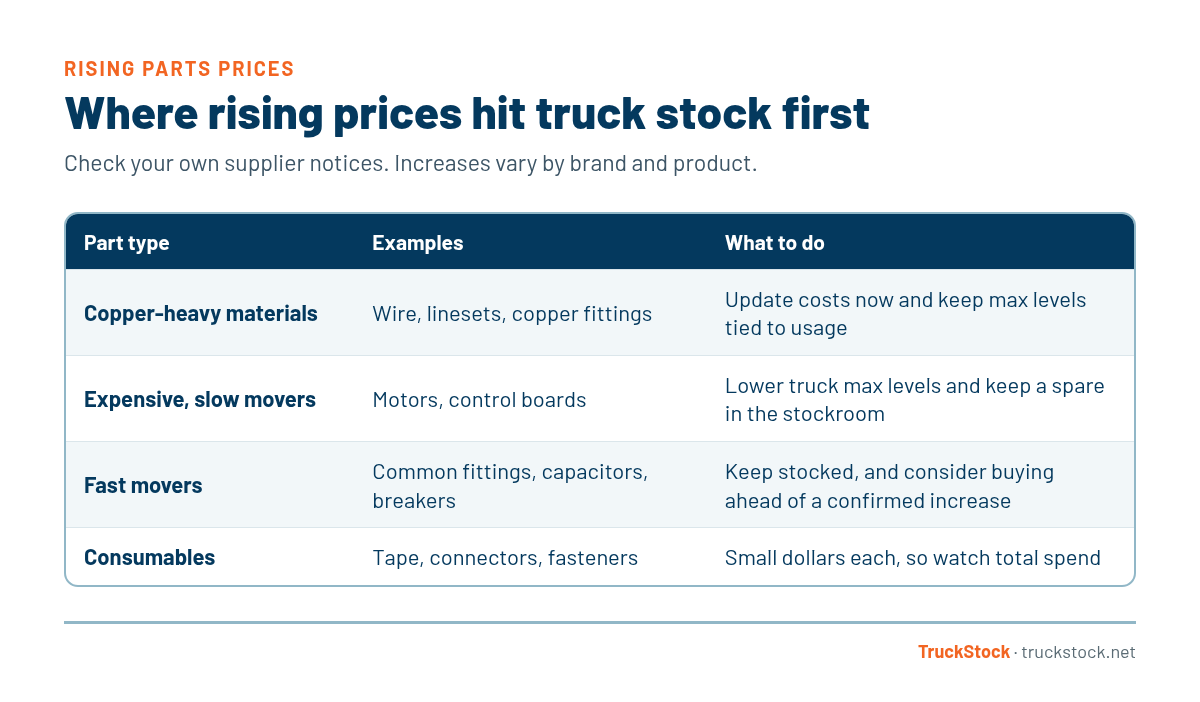
Where Rising Prices Hit Truck Stock First
How to Respond, Step by Step
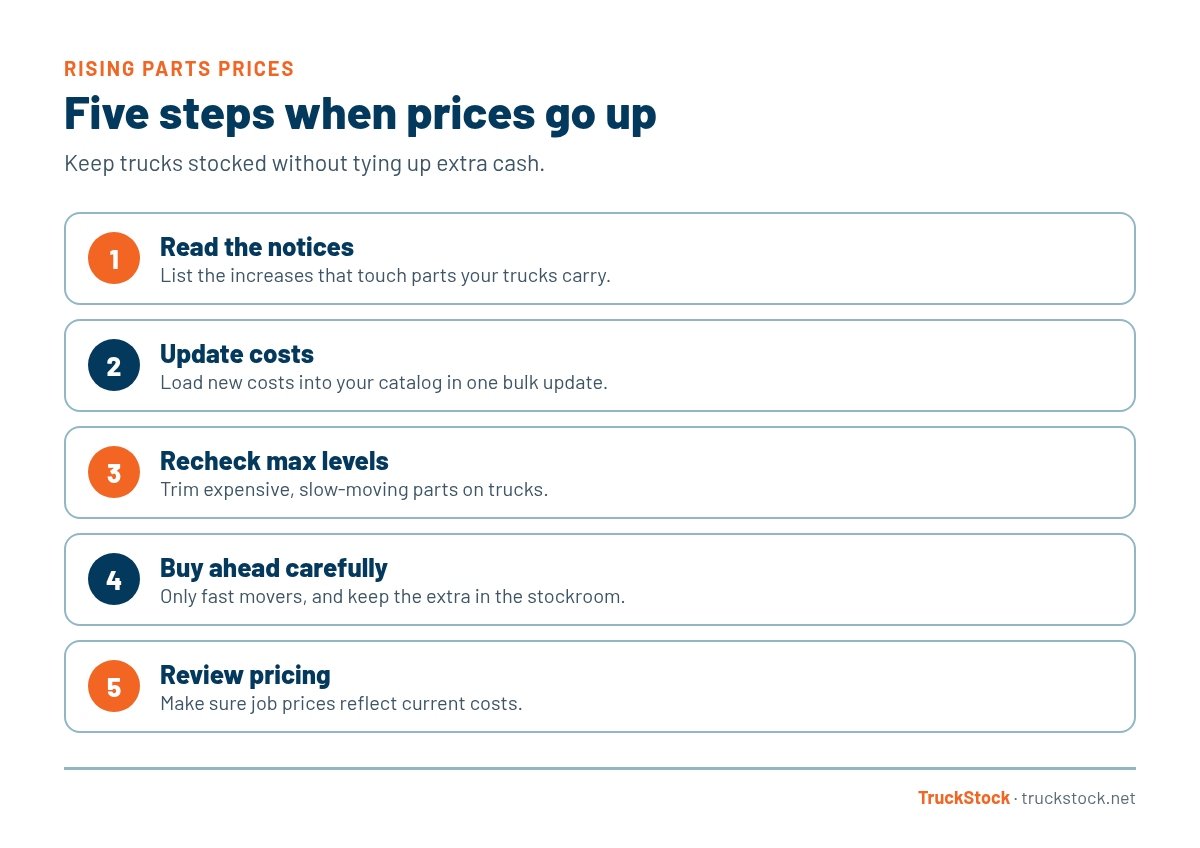
1. Read the supplier notices
Price increase letters usually name the product lines and the date the change takes effect. Make a short list of the ones that touch parts your trucks actually carry.
2. Update costs in your catalog
Put the new costs on each part as soon as you have them, ideally in one bulk update from the supplier’s price list. Our post on managing supplier part numbers and costs walks through the setup.
3. Recheck max levels on expensive parts
Higher prices make overstock more costly. Look at high-dollar parts that sit on trucks for months, such as motors or control boards, and ask whether every truck needs one or whether one in the stockroom will do. Our guide to setting min and max levels covers how to adjust them.
4. Buy ahead only where it pays
Ordering before an increase can make sense for parts you use every week, like common fittings, wire, or capacitors, when you know the date and the amount. It rarely pays for slow movers. Stock up in the stockroom, not on the trucks, so you keep control of it.
5. Review your own pricing
Once costs are current, check that your job pricing and flat rates reflect them. A small increase on a part you use on dozens of jobs a month adds up fast.
Why Hoarding Usually Backfires
When prices climb, it’s tempting to load up every truck. That spreads cash across vans where it’s hard to see and raises the cost of parts that go missing. A steady restocking routine keeps trucks ready without the extra risk. Here’s a simple restocking routine that works, and ways to reduce lost and missing parts while the dollars on board are higher.
A Quick Example
Picture an HVAC company that gets a notice that linesets and some motors are going up next month. The office updates costs for those parts in one upload. The service manager sees that every truck carries two of a motor the team uses only a few times a quarter, so he lowers that max to one and keeps a spare in the stockroom. He places one stockroom order for linesets before the new price takes effect, because they go out on installs every week. Trucks keep getting restocked on the usual schedule.
Common Mistakes
- Leaving old costs in the catalog for months after a price change.
- Loading every truck with extra stock before an increase.
- Buying ahead on slow movers that may never get used.
- Forgetting to update job pricing once costs change.
How TruckStock Handles It
- Supplier costs on every part. Each part can list its suppliers, part numbers, and costs.
- CSV supplier uploads. Update costs in bulk from a price list, and review every change before it’s applied.
- Max levels by truck type. Change a max once, and every truck of that type follows.
- Usage reports. The Items Requested report groups by part, truck, job, or supplier, so you can see where the dollars go.
Key Takeaways
- Update part costs as soon as new prices are confirmed.
- Lower max levels on expensive, slow-moving parts.
- Buy ahead only on fast movers, and keep extra stock in the stockroom.
- Keep restocking trucks on your normal routine.
- Make sure your job pricing reflects your current costs.
Frequently Asked Questions
Should I stock up on parts before a price increase?
Only on parts you use often, when you know the date and amount of the increase. Keep the extra in the stockroom, not spread across trucks.
How often should I update part costs?
Every time a supplier sends a new price list or increase notice. In a fall like this one, that may mean more than once.
Should I lower max levels when prices go up?
For expensive parts that sit on trucks for a long time, often yes. For fast movers, keep max levels where your usage supports them, or trucks will run short.
Do higher prices change how I should restock trucks?
Not the routine. Keep restocking on schedule. What changes is how much you keep on board for high-dollar, slow-moving parts.
Want your costs and max levels in one place? Start a free TruckStock trial or contact our team.
Recent Comments