

To do a full inventory count on a service truck, pick a set time when the truck is parked, work through it one section at a time, and count every part against a standard list for that type of truck. Record the real count, not what the truck should have, then fix the records and restock the gaps before the truck goes back out.
The start of the year is a natural time to do it. Busy season is behind you for many trades, and a clean count gives you an honest baseline for the months ahead. It also pays off fast, because a part you think is on the truck but isn’t is exactly the kind of surprise we described in how missing one part can cost hundreds of dollars.
Before You Start
- Pick a time the truck isn’t needed. Early morning, end of day, or a slow afternoon. Don’t try to count a truck that’s about to leave.
- Print or pull up the standard list for that truck type, sorted in the same order the truck is laid out.
- Clear out the junk first. Pull empty boxes, old paperwork, and returns so you’re only counting real stock.
- Plan for two people if you can. One counts, one records. It’s faster and catches more mistakes.
How to Count a Service Truck, Step by Step
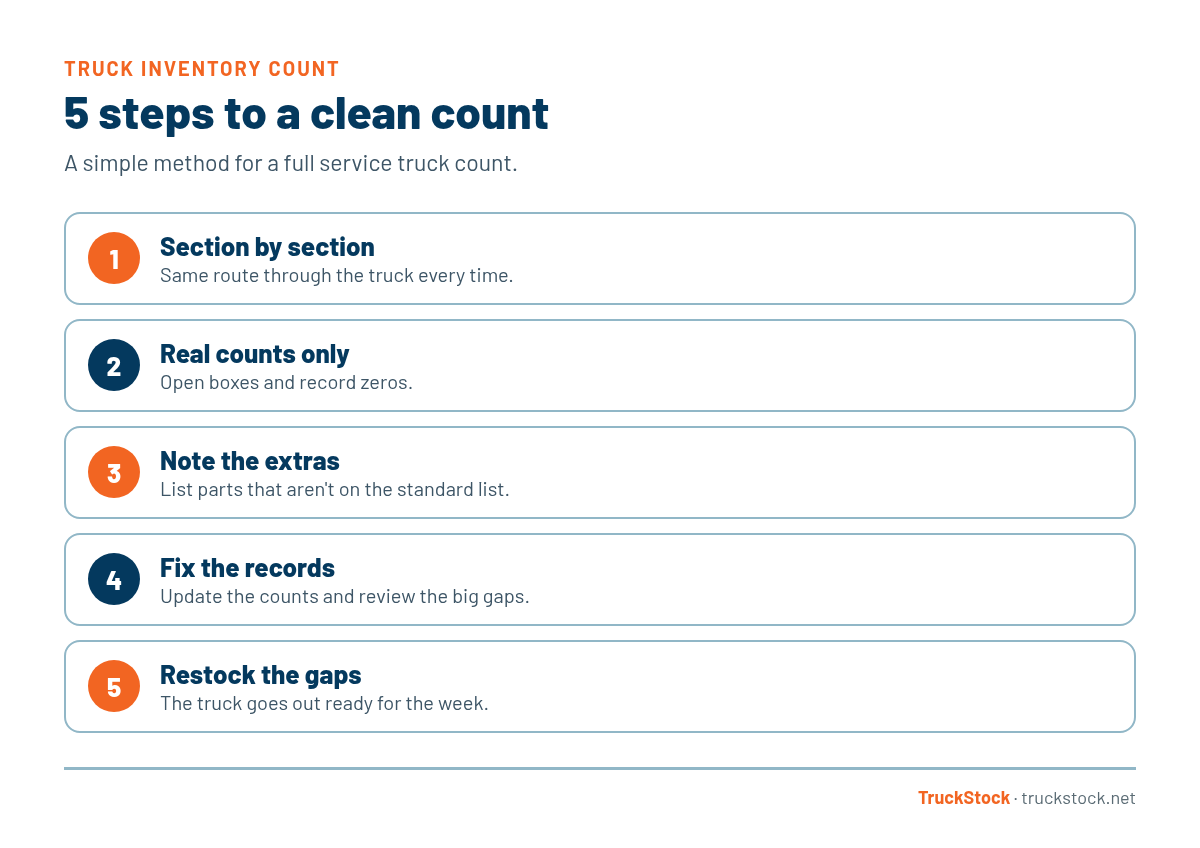
1. Count by section, in the same order every time
Start at one end of the truck and work around it, shelf by shelf and bin by bin. Using the same route every time makes it easy to pick up where you left off and hard to skip a section.
2. Count what’s there, not what should be there
It’s tempting to glance at a bin and write down the expected number. Don’t. Open boxes, check partial packs, and write the real count, even when it’s zero.
3. Note parts that aren’t on the list
Every truck collects extras: a leftover part from an install, a special order that never got used. Write them down separately. Some belong back in the stockroom. Some might mean your standard list is missing something.
4. Compare and fix the records
Once the count is done, compare it to what your records say. Update the records to match reality, then look at the biggest gaps. A part that’s always short or always over is telling you something about your process or your max levels.
5. Restock the gaps before the truck goes out
Fill anything below where it should be, so the truck starts the week ready. If you haven’t set max levels yet, this is a good moment to do it. Here’s how to set min and max levels for service truck inventory.
How Often Should You Do a Full Count?
If parts usage, restocks, and transfers are recorded as they happen, a full count once or twice a year is usually enough, with quick spot-checks in between. If you’re not tracking usage yet, you’ll need to count more often, because the records drift fast. That’s one more reason to build a simple daily routine like the one in how to keep service trucks stocked.
How TruckStock Handles It
- Count against the right list. Each truck follows its truck type’s parts list and max quantities, so you always know what “full” looks like.
- Fix counts in bulk. Download a truck’s inventory to Excel, enter the real counts, and upload it back. TruckStock shows the changes for review before anything is applied, and keeps an upload history.
- Quick fixes on the spot. Admins can adjust a single part, fill a part to its max, or use “Stock All” when a truck has just been fully loaded.
- See the result. The Available Stock report shows every part on a truck against its max, so you can confirm the truck is ready.
Key Takeaways
- Count when the truck is parked and not needed.
- Work section by section in the same order every time.
- Record the real count, including zeros.
- Update your records, then restock the gaps right away.
- Track usage daily so full counts are only needed once or twice a year.
Frequently Asked Questions
How long does it take to count a service truck?
It depends on how many parts the truck carries and how organized it is. A well-organized truck with a standard list goes much faster than one that’s been stocked differently by every tech. Two people working together are faster than one.
Should technicians count their own trucks?
Techs know their trucks best, so it helps to have them involved. For a full count, pairing the tech with a manager or stockroom person keeps it accurate and gives both sides confidence in the result.
What should I do with parts that aren’t on the standard list?
Record them separately. Return special-order or leftover parts to the stockroom. If the same extra part keeps showing up on trucks, consider adding it to the standard list.
Want a cleaner starting point for the year? Start a free TruckStock trial and see how truck counts, max levels, and Excel uploads work with sample data, or contact our team.
Recent Comments