

A service truck should carry enough parts to finish the jobs it runs most often between restocks, plus a short list of must-carry parts that would stop a job if missing. Anything beyond that is better kept in the stockroom, where it can serve the whole fleet instead of riding around on one truck.
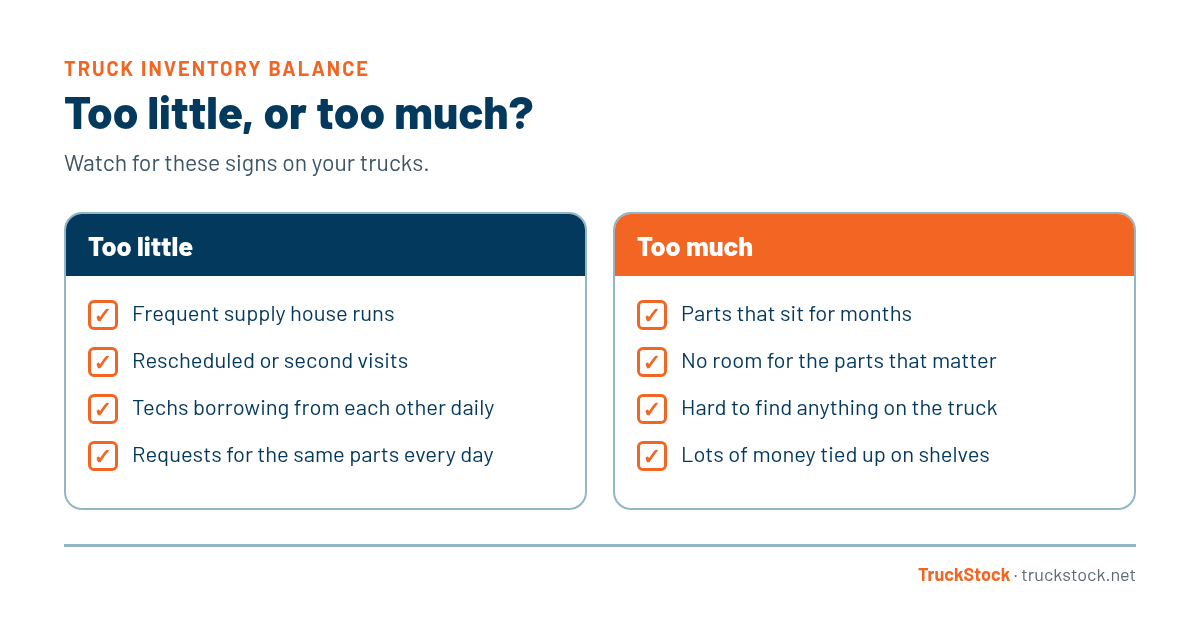
There are two ways to get this wrong. Carry too little and techs make extra trips, reschedule customers, and lose billable time. Carry too much and you tie up money in parts that sit for months, run out of space for the parts that matter, and make it harder to find anything. The goal is a truck that can handle most calls without becoming a rolling warehouse of everything you own. Our post on why every service truck is a rolling warehouse lays out the basics.
Signs a Truck Carries Too Little or Too Much
How to Find the Right Amount
1. Start with your most common jobs
List the jobs each truck type runs most often and the parts those jobs need. Those parts should always be on the truck. This list usually covers the large majority of what techs reach for in a typical week.
2. Add must-carry parts
Some parts are rarely used but will end a call if they’re missing. Carry one or two of those. They’re what protect your first-time fix rate on the unusual calls.
3. Size quantities to your restock schedule
If you restock daily, trucks can carry less, because they’re refilled every night. If you restock weekly, they need more. Here’s how to set min and max levels based on that.
4. Move slow movers to the stockroom
If a part sits on a truck for months without being used, and it isn’t a must-carry, move it to the stockroom. One shared part in the stockroom can cover several trucks instead of one per truck.
5. Review every season
What a truck needs changes with the season and the work. Look at usage every few months and trim parts that aren’t moving. Our post on reporting on parts usage explains how.
Common Mistakes
- Letting each tech decide what to carry, so every truck is different.
- Carrying “just in case” parts that never get used.
- Forgetting how restock frequency changes what a truck needs.
- Never moving slow movers back to the stockroom.
- Measuring truck stock by how full it looks instead of by usage.
A Quick Example
Imagine two HVAC service trucks. One carries a little of everything, including parts that haven’t moved in a year. The other carries a focused list built from common jobs, a few must-carry parts, and nothing else. The first truck looks more prepared, but its tech spends more time hunting for parts and still runs out of the fast movers.
The second truck is easier to restock, easier to search, and usually better prepared for the calls that actually come in. More parts isn’t the same as the right parts.
How TruckStock Handles It
- Truck types with max levels. Each truck type has a parts list with a max for every part, so every truck carries the right amount.
- A max of 0 means no. Set a part to 0 on a truck type to keep it off those trucks entirely.
- Available Stock report. See each part on a truck against its max to spot overloaded or underloaded trucks.
- Usage by part and truck. The Items Requested report shows which parts actually move, so you can trim the ones that don’t.
Key Takeaways
- Carry what your most common jobs need, plus must-carry parts.
- Size quantities to how often you restock.
- Keep slow movers in the stockroom.
- Use the same list for every truck of the same type.
- Review usage every season and trim what isn’t moving.
Frequently Asked Questions
Is it better to overstock or understock a service truck?
Neither. Understocking costs trips and callbacks, and overstocking ties up money and space. Aim for the parts your common jobs need plus a few must-carry items.
How do I know if a part should be on the truck?
If it’s used often on common jobs, or it would stop a job if missing, it belongs on the truck. If it rarely moves and isn’t critical, keep it in the stockroom.
Should install trucks carry the same stock as service trucks?
Usually not. Install work tends to be planned, so materials can be pulled for each job. Service trucks need more general stock for unplanned calls.
How often should I review what trucks carry?
Every season is a good rhythm, plus any time you add a new type of work.
Want to find the right balance for your fleet? Start a free TruckStock trial or contact our team.
Recent Comments