

To plan stockroom inventory before the summer HVAC rush, start with how much of each part you used last summer, adjust for any trucks or techs you’ve added, and order early for parts with long lead times. Keep enough in the stockroom to refill every truck to its max for at least a few busy days without a delivery.
Truck stock gets most of the attention, but trucks are only as ready as the stockroom behind them. When the first heat wave hits and every truck burns through capacitors and contactors in a day, the stockroom has to refill all of them overnight. If it can’t, trucks start the next day short and the trouble snowballs. Our post on seasonal rotations covers the truck side. This one is about the shelves behind them.
How to Plan Stockroom Levels for Summer
1. Pull last summer’s usage
Look at parts requested from trucks during last summer’s busiest weeks. That’s your baseline for how fast the stockroom empties. If you’re new to tracking this, our post on reporting on parts usage explains what to look for.
2. Adjust for growth
If you’ve added trucks or techs since last summer, scale up. More trucks means more parts going out every night. A simple way to start is to estimate usage per truck from last year and multiply by your current truck count.
3. Plan for the worst week, not the average
Averages hide the heat waves. Look at your busiest week last summer and make sure the stockroom could have handled it, even if a supplier delivery was late. That’s the week that decides whether customers wait.
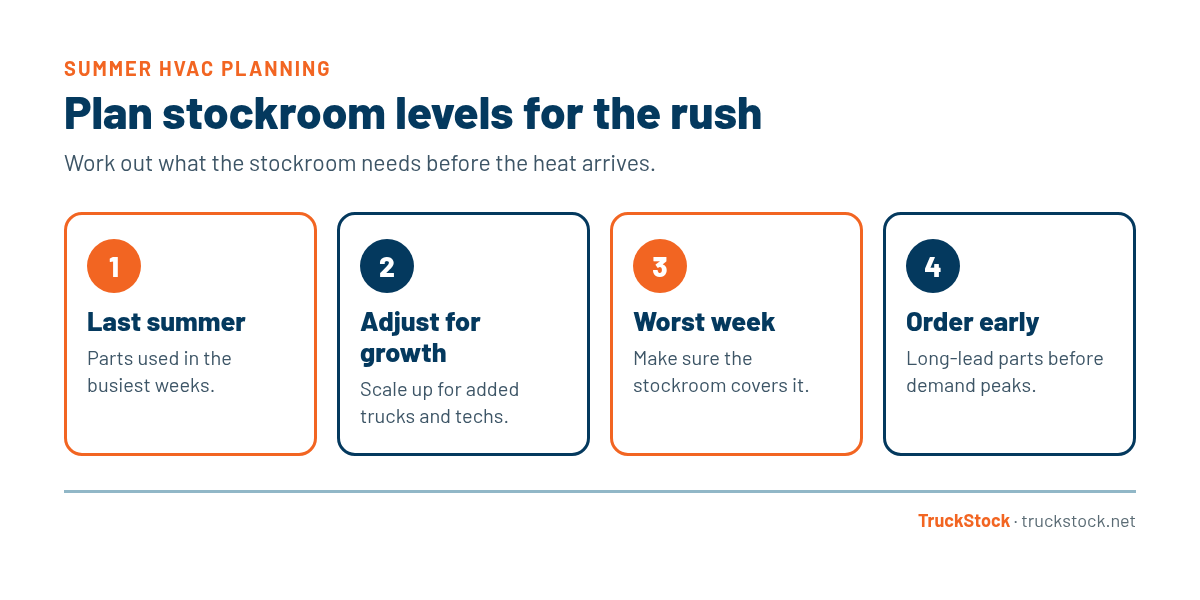
4. Order long-lead parts early
Some parts take longer to get in the middle of summer, when every contractor in your area wants them. Talk to your suppliers in spring about what tends to get tight, and place those orders before demand peaks.
5. Watch levels weekly during the season
Once summer starts, check stockroom levels every week, or more often during heat waves. Reorder before you hit bottom, not after. A simple weekly review of what’s running low keeps surprises to a minimum.
6. Wind down in late summer
As the season tapers off, slow down reorders on summer-only parts so you’re not left with a shelf full of them in the fall. Then shift your attention to heating season.
Common Mistakes
- Planning from average weeks instead of the busiest ones.
- Forgetting to account for trucks added since last summer.
- Waiting until demand peaks to order long-lead parts.
- Checking stockroom levels only when a shelf is empty.
- Over-ordering summer parts late in the season.
A Quick Example
Picture a shop that added two trucks over the winter. Last summer, the stockroom barely kept up during the worst heat wave. This year, with more trucks pulling from the same shelves, the same stock levels would leave several trucks short by the second day.
Planning from the busiest week and adjusting for the new trucks shows that gap months ahead, while there’s still time to order. That’s the whole point of planning early: you find the problem on paper in April, not on a 95 degree afternoon in July.
How TruckStock Handles It
- Stockroom inventory. Each stockroom has its own counts, which managers can view and edit.
- Fulfillment checks. When managers fulfill from a stockroom, TruckStock won’t send more than is on hand, and low stock is highlighted in red and yellow.
- Usage history. The Items Requested report shows what went out by part, truck, or supplier over any date range, so you can plan from last summer’s real numbers.
- Excel inventory updates. Download stockroom inventory, update it after a big delivery, and upload it back with a review step.
Key Takeaways
- Use last summer’s usage as your baseline.
- Scale up for trucks and techs you’ve added.
- Plan for your busiest week, not the average one.
- Order long-lead parts before demand peaks.
- Watch stockroom levels weekly during the season.
Frequently Asked Questions
How far ahead should I plan for the summer HVAC rush?
Start in spring, a couple of months before your typical first heat wave. That leaves time to talk with suppliers and place early orders.
How much should the stockroom hold compared to the trucks?
Enough to refill every truck to its max for several busy days without a delivery. Your own busiest week from last summer is the best guide.
What if I don’t have last year’s usage data?
Start tracking now and use supplier invoices from last summer as a rough guide. Even a season of real data makes next year’s plan much better.
Should every part get extra stock for summer?
No. Focus on the parts that spike in summer. Year-round parts can stay at their normal levels.
Want to see stockroom and truck inventory together? Start a free TruckStock trial with sample HVAC data, or contact our team.
Recent Comments