

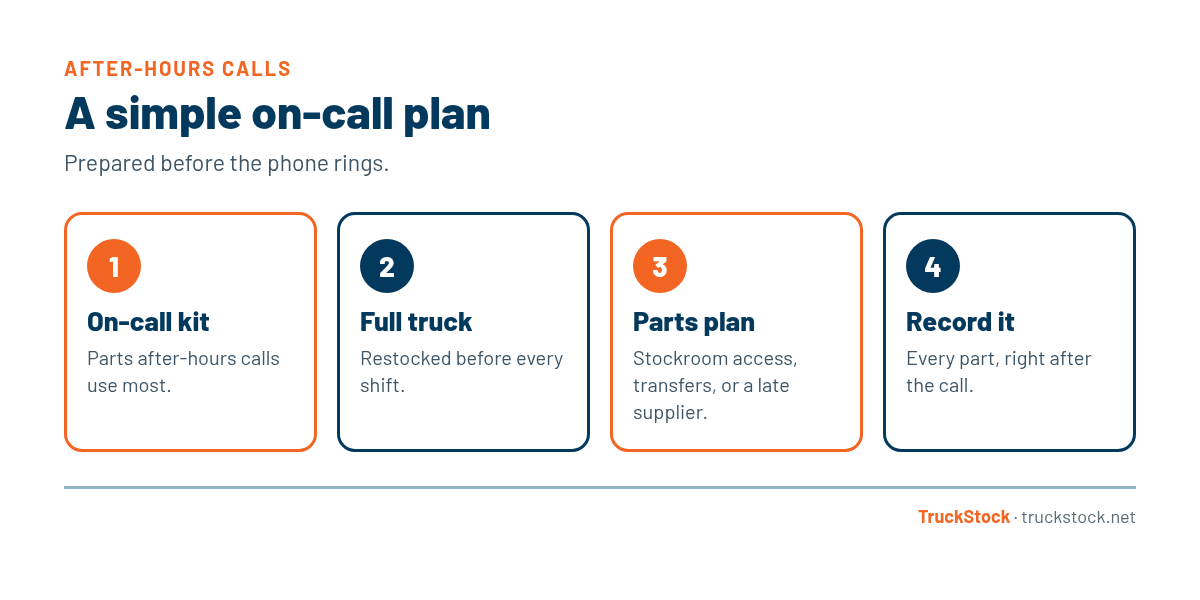
To handle after-hours calls when the truck is missing a part, plan ahead: give on-call techs a focused kit of the parts emergency calls use most, set a clear plan for getting parts when the stockroom is closed, and make sure every part used overnight is recorded so the truck is restocked first thing the next day.
Summer nights bring no-cool calls, and they always seem to come when the stockroom is locked and the supply house is closed. The on-call tech is often alone, tired, and trying to get a family’s air running again. If the truck has the part, it’s a quick fix and a grateful customer. If it doesn’t, it’s a temporary patch and a callback in the morning. Our post on how missing one part can cost hundreds shows what that costs.
Build an On-Call Plan
How to Prepare, Step by Step
1. Look at past after-hours calls
Pull your after-hours jobs from last summer and list the parts used. Emergency calls tend to repeat the same handful of failures. That list becomes your on-call kit.
2. Make sure the on-call truck is full
Before an on-call shift starts, the truck should be restocked to its max, with the on-call kit topped off. Don’t hand the on-call phone to a tech whose truck ran low that afternoon. The routine in how to keep service trucks stocked helps here.
3. Decide how to get parts after hours
Write down what the tech should do if a part isn’t on the truck. Can they get into the stockroom? Is there a nearby tech who can transfer a part? Is there a supplier with late hours? A clear plan saves a lot of late-night phone calls.
4. Record everything used overnight
Parts used on after-hours calls need to be recorded just like daytime calls, ideally right after the job. That way the stockroom refills the truck in the morning, and the next on-call tech starts with a full kit.
5. Review after each busy stretch
After a heat wave, look at what on-call techs needed and didn’t have. Add those parts to the kit or raise their max. Each review makes the next busy stretch smoother.
A Quick Example
Picture an on-call tech who gets a no-cool call at 9 p.m. and finds a failed capacitor. If capacitors are in the on-call kit, it’s a quick repair. If not, the tech checks whether another tech nearby has one and records a transfer, or uses the after-hours stockroom access the plan allows. Either way, the part is recorded, and the truck is refilled first thing in the morning.
Compare that to a tech improvising at night with no plan: calling around, waking up a manager, and finally telling the customer someone will be back tomorrow. The difference isn’t skill. It’s preparation.
Common Mistakes
- Starting an on-call shift with a truck that’s already low.
- No written plan for getting parts after hours.
- Forgetting to record overnight parts, so the truck isn’t restocked.
- Borrowing from another truck without recording a transfer.
- Never reviewing what on-call techs were missing.
Why After-Hours Calls Are Different
During the day, a missing part is a hassle. After hours, it can mean the job doesn’t get finished at all. Supply houses are closed, the stockroom may be locked, and there’s nobody to run a part out. The tech has only what’s on the truck and whatever plan you gave them.
After-hours calls also tend to be the ones customers remember. A family without air on a hot night will remember whether the problem was fixed that night or the next afternoon. That’s a good reason to treat on-call stock as its own small project instead of hoping the truck happens to have what’s needed.
How TruckStock Handles It
- Works anytime, on any phone. Techs can record parts used right after an after-hours call from their phone’s browser.
- Truck-to-truck transfers. If a nearby tech has the part, they transfer it and the on-call tech accepts it, so both trucks stay accurate.
- Morning restocking. Overnight requests are waiting for the stockroom first thing, grouped by truck.
- Current truck inventory. Techs can check what’s on their truck before they head out to a call.
Key Takeaways
- Build an on-call kit from past after-hours calls.
- Start every on-call shift with a full truck.
- Write down how to get parts after hours.
- Record every part used overnight.
- Review the kit after each busy stretch.
Frequently Asked Questions
What should be in an HVAC on-call kit?
The parts your after-hours calls use most, based on your own history. For many HVAC companies, that includes common capacitors, contactors, fuses, and motors.
Should on-call techs have stockroom access after hours?
That depends on your shop and security. Some companies allow it with a clear sign-out process. Others rely on transfers between trucks. Either way, write the plan down.
How do I make sure overnight parts get restocked?
Have techs record parts right after each call, and have the stockroom check requests first thing every morning.
Do after-hours calls need a different truck?
Usually not. A well-stocked service truck with a topped-off on-call kit is enough for most fleets.
Want on-call techs to start every shift ready? Start a free TruckStock trial or contact our team.
Recent Comments