

To prepare service trucks for cold weather, protect materials that don’t handle freezing well, shift stock toward the calls winter brings, clear out summer extras, and count each truck before the season starts. Doing it in early fall, before the first hard freeze, means trucks are ready when the cold calls start.
In June we wrote about protecting heat-sensitive parts. Cold brings its own set of problems. Some materials stiffen, separate, or fail when they freeze. Batteries lose charge faster. And the calls themselves change, so the parts trucks carry should too. Fall is the right time to get ahead of it.
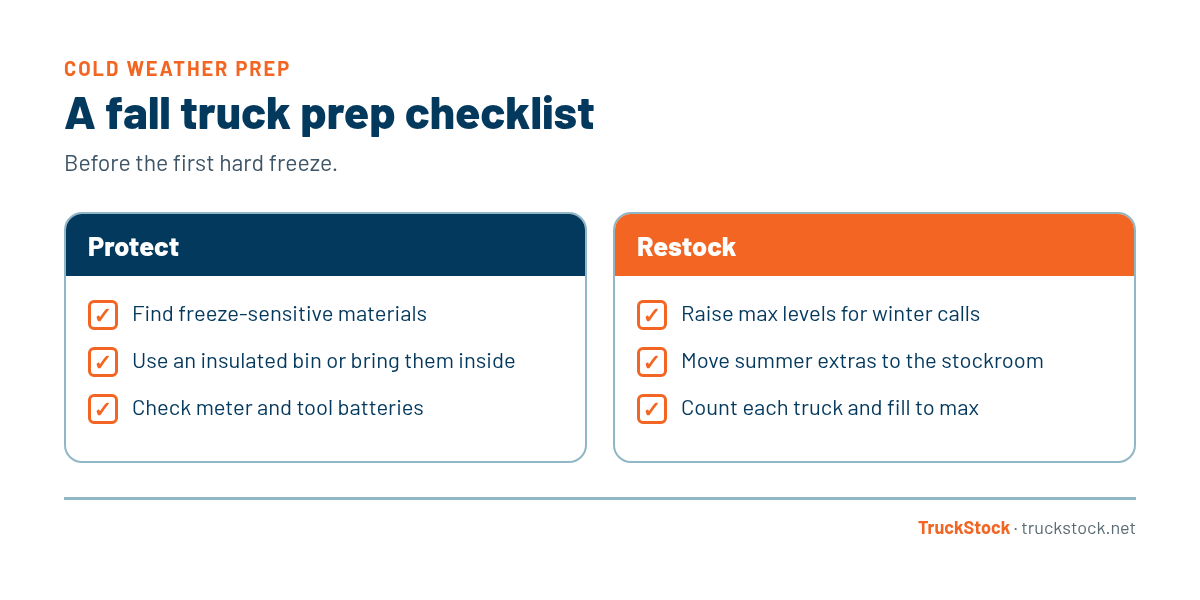
A Fall Truck Prep Checklist
How to Prepare, Step by Step
1. Find freeze-sensitive materials
Check product labels and manufacturer guidance for sealants, adhesives, caulks, and water-based products. Anything with a minimum storage temperature needs a plan. Batteries for meters and tools also lose charge faster in the cold.
2. Protect or move them
Keep freeze-sensitive items in an insulated bin, bring them inside overnight, or carry smaller quantities and restock more often. Moving some to the stockroom for the winter is a fine option too.
3. Shift stock toward winter calls
Raise max levels on parts winter calls use and lower them on summer-only parts. Our post on seasonal truck stock explains how to plan the shift, and trade-specific posts like frozen and burst pipe calls cover the details.
4. Clear out summer extras
Parts that piled up over the summer and won’t be needed until spring can go back to the stockroom. That frees room for winter stock. Here’s how to reduce dead stock.
5. Count each truck
A count before the season gives you an accurate starting point when it gets busy. The steps in doing a full inventory count apply.
Why Fall Is the Right Time
Once cold weather hits, everyone is busy. Techs are running calls back to back, the stockroom is filling requests all day, and nobody has time to reorganize trucks. A few hours in early fall saves a lot of scrambling later.
It also gives you time to order. If winter parts need to come from suppliers, ordering in September or early October is far easier than ordering during the first cold snap, when everyone else is ordering the same parts.
A Quick Example
Picture a mixed-trade company in late September. Each tech spends part of a Friday afternoon on their truck. They move sealants and adhesives into an insulated bin, pull summer extras for the stockroom, and count what’s left. The service manager updates max levels on each truck type for winter, and over the next week the stockroom restocks every truck to the new levels. When the first cold calls come in, the trucks are ready.
Common Mistakes
- Leaving freeze-sensitive materials in the truck overnight all winter.
- Keeping summer max levels into the cold season.
- Waiting for the first cold snap to order winter parts.
- Skipping the pre-season count.
- Forgetting that batteries drain faster in the cold.
Think About Where Trucks Park
Trucks parked inside a heated shop overnight have very different needs from trucks that go home with techs and sit in a driveway. If some of your trucks park outside, those are the ones to focus on for freeze-sensitive materials.
It’s worth asking each tech where their truck spends the night. The answer may change which items should stay on the truck in winter and which should live in the stockroom until spring.
Cold mornings also slow everything down. Frozen doors, stiff latches, and icy steps make it harder to get into bins quickly. A truck that’s organized before winter, with the most used parts easiest to reach, saves time on every cold call.
How TruckStock Handles It
- Seasonal max levels. Update max levels on the truck type and every truck of that type follows.
- Transfers and returns. Move summer extras back to the stockroom and keep counts accurate.
- Fill to max. Restock each truck to its new winter levels with one action.
- Available Stock report. See every truck against its max to spot gaps before the season starts.
Key Takeaways
- Protect freeze-sensitive materials before the first hard freeze.
- Shift max levels toward winter calls.
- Move summer extras back to the stockroom.
- Count every truck before the season.
- Order winter parts early.
Frequently Asked Questions
Which materials are most affected by freezing?
Water-based products, some sealants, caulks, and adhesives, and batteries. Check manufacturer guidance for each product.
Should I bring materials inside overnight in winter?
For freeze-sensitive items, yes, or keep them in an insulated bin. Carrying smaller quantities also helps.
When should I start preparing trucks for winter?
Early fall, before the first hard freeze and before the busy season starts.
Do all trades need winter truck prep?
Most do. The specific parts differ, but every trade sees different calls in cold weather.
Want an easier seasonal switch? Start a free TruckStock trial or contact our team.
Recent Comments