

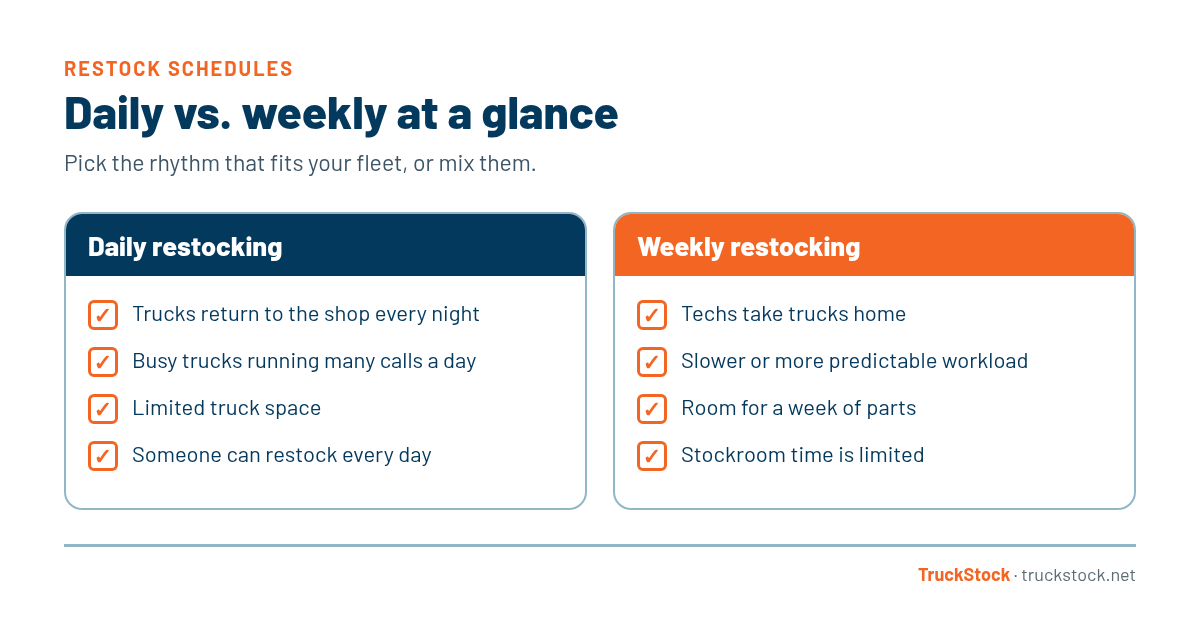
Daily restocking works best for busy fleets whose trucks return to the shop every night, because trucks can carry less and still start every day full. Weekly restocking works better for slower fleets or techs who take trucks home and rarely come to the shop, but trucks need to carry more to make it through the week. Many fleets mix the two.
There’s no single right answer. The best schedule depends on how busy your trucks are, how far they are from the stockroom, how much they can hold, and who does the restocking. The mistake is not picking a schedule at all, and restocking whenever someone remembers. A clear rhythm is what makes the routine in how to keep service trucks stocked work.
Daily vs. Weekly at a Glance
How to Choose a Restock Schedule
1. Look at where trucks are at night
If trucks come back to the shop every evening, daily restocking is easy. If techs take trucks home and start from there, a daily stop at the shop costs real drive time. In that case, weekly or a couple of times a week may be the better trade.
2. Look at how fast trucks use parts
A truck running several service calls a day can burn through common parts quickly. If trucks regularly run out before the end of the week, they either need more stock or more frequent restocks. Your usage history will tell you which way to lean.
3. Look at truck space
Weekly restocking means trucks need to carry roughly a week of parts. If they don’t have room, daily or twice-weekly is the answer. Here’s how much inventory a service truck should carry.
4. Look at stockroom staffing
Daily restocking takes steady effort from whoever runs the stockroom. Make sure someone has the time, every day, before you commit to it. A schedule that gets skipped is worse than a slower schedule that always happens.
5. Mix when it makes sense
Many fleets restock fast movers daily and everything else weekly, or go daily in busy season and weekly in slow months. That’s fine, as long as everyone knows the plan.
Whatever you choose, write it down and share it. Techs should know when restocks happen and what time parts need to be recorded to make the next one. That one detail removes a lot of frustration on both sides.
A Quick Example
Picture a fleet where most trucks park at the shop, but two techs live far out and take their trucks home. The shop trucks get restocked every night. The two remote trucks carry a little more stock and come in twice a week, with transfers from nearby trucks covering the occasional gap. Everyone knows the plan, and nobody is guessing. Our post on direct vs. stockroom fulfillment covers a related choice about who pulls the parts.
Common Mistakes
- No set schedule, so restocking happens only when someone complains.
- Choosing daily restocking without the staff to keep it up.
- Weekly restocking with trucks too small to hold a week of parts.
- Using the same schedule in peak season and slow season.
- Not telling techs when restocks happen.
How TruckStock Handles It
- Works with any schedule. Requests build up as techs record parts, and managers fulfill them whenever restocking happens.
- Two request types. Techs can record parts used off the truck, or request a top-up to replenish stock, which changes the count only when parts arrive.
- Pending view. The Pending Request List shows what’s still waiting to be filled for each truck.
- Transfers for the gaps. If a truck runs short between restocks, a nearby tech can transfer parts and the receiving tech accepts them.
Key Takeaways
- Daily restocking suits busy fleets that return to the shop each night.
- Weekly suits slower fleets or trucks that rarely come to the shop.
- Truck space and stockroom staffing should shape your choice.
- Mixing schedules is fine if everyone knows the plan.
- Any schedule beats restocking whenever someone remembers.
Frequently Asked Questions
Is daily restocking always better?
Not always. It keeps trucks fuller with less stock on board, but it takes daily effort and works best when trucks come back to the shop every night.
How do I restock trucks that techs take home?
Many fleets restock those trucks once or twice a week and have them carry a bit more stock. Transfers between nearby trucks can cover gaps in between.
Should restock schedules change by season?
Often, yes. Busy seasons may call for daily restocking, while slower months can shift to a lighter schedule.
What time of day is best for restocking?
Whatever fits your shop. Many fleets stage parts in the afternoon or evening so techs can load up first thing in the morning.
Want to see how requests build up between restocks? Start a free TruckStock trial or contact our team.
Recent Comments