
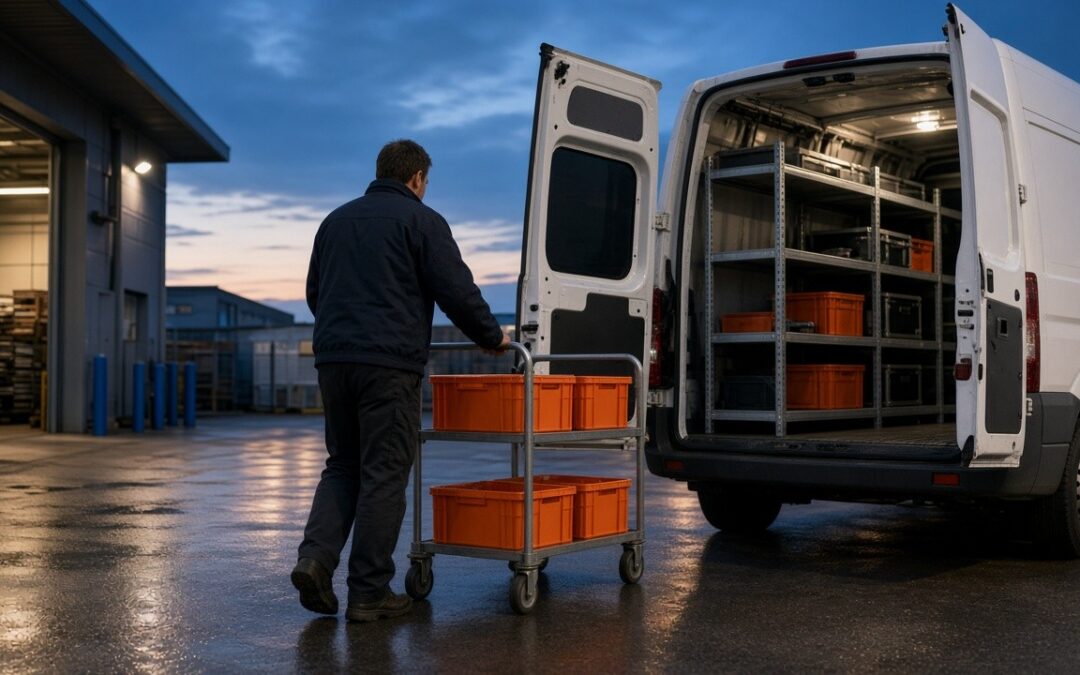
To set up a stockroom for fast truck restocking, group parts in the same categories your trucks and catalog use, put the fastest-moving parts closest to where trucks load, label every bin with one clear name, and set aside a staging area where each truck’s refill is gathered before it’s loaded. The goal is fewer steps between a restock request and a full truck.
A good restock process can still be slow if the stockroom fights you. When the person pulling parts walks the whole building for every request, restocking takes longer, mistakes creep in, and trucks leave short. Layout is one of the cheapest fixes you can make, because it mostly costs an afternoon of moving shelves. It pairs well with the process tips in our post on fulfillment best practices for warehouse managers.
A Simple Stockroom Layout
How to Set It Up, Step by Step
1. Match your catalog categories
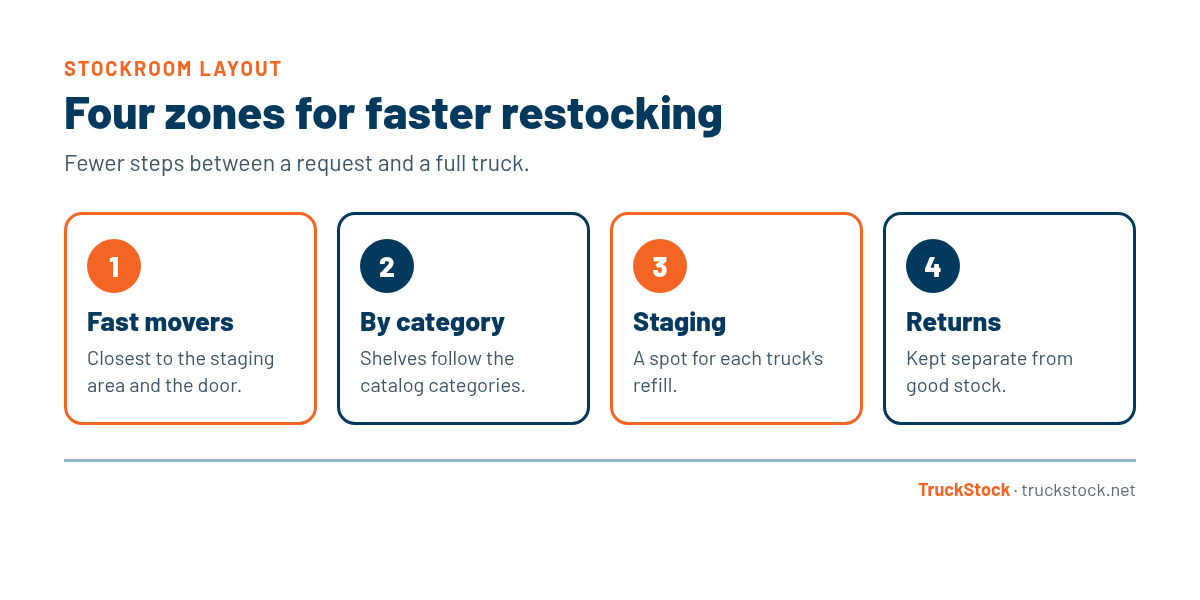
Arrange shelves by the same categories your parts catalog and trucks use. When a request lists parts by category, the person pulling them can walk the shelves in that order. If your categories need work, start with how to organize a parts catalog.
2. Put fast movers by the door
Look at which parts go out most often and move them closest to the staging area. Your usage reports make this easy to figure out. Slow movers and bulk items can live further back, since they’re pulled less often. Our post on reporting on parts usage explains how to find your fast movers.
3. One part, one bin, one label
Every bin should hold one part, with a label that matches its name in the catalog exactly. Mixed bins are where wrong parts and miscounts come from. Clear labels also make it easier for anyone to help out when the regular stock person is out.
4. Add a staging area
Set aside a table, shelf, or cart for each truck, or for each route. As parts are pulled, they go into that truck’s spot. Techs can then load everything at once instead of waiting while parts are gathered.
5. Keep a returns spot
Give returned and defective parts their own clearly marked area so they never get mixed back into good stock. We cover how to handle them in our post on returns and defective parts.
A Quick Example
Picture a stockroom where fittings are on one wall, electrical parts across the room, and filters in a back corner. Every truck’s refill means crossing the building several times. Now picture the same parts grouped by category in the order of the request form, with the busiest parts next to a staging table by the door. The parts didn’t change. The walking did.
Small changes like that add up over every restock, every day. They also make the stockroom easier for a new person to learn, which matters when the regular stock manager takes a vacation.
Common Mistakes
- Arranging the stockroom by supplier instead of by how parts are used.
- Keeping fast movers in the back because that’s where they started.
- Mixing several parts in one bin.
- Labels that don’t match the catalog name.
- No separate place for returns and defective parts.
How TruckStock Handles It
- Requests grouped by truck. Managers see open requests grouped by truck, which works naturally with a staging spot per truck.
- Fulfill All In Truck. Send everything a truck needs in one step once it’s staged.
- Stockroom counts. Each stockroom has its own inventory, and fulfillment won’t send more than the stockroom has on hand.
- Categories everywhere. The same part categories show up in the catalog, in requests, and in reports, so your shelves can follow them too.
Key Takeaways
- Arrange shelves by the categories your catalog uses.
- Keep fast movers closest to the staging area.
- Use one part per bin with a label that matches the catalog.
- Stage each truck’s refill before loading.
- Keep returns and defective parts separate.
Frequently Asked Questions
How big does a stockroom need to be for a service fleet?
It depends on your fleet size, your parts list, and how often you get deliveries. Many small fleets work out of a single room or a section of the shop. Layout matters more than size.
Should the stockroom be organized by supplier or by part type?
By part type, in the same categories your trucks use. Supplier information belongs in your catalog, not on your shelves.
Do I need a staging area if I only have a few trucks?
It still helps. Even a single shelf or cart per truck makes loading faster and cuts down on mistakes.
How often should I rearrange the stockroom?
Review it once or twice a year, or when the work changes. If your fast movers shift with the season, it may be worth moving them closer to the door during that season.
Want to see how requests flow from stockroom to truck? Start a free TruckStock trial or contact our team.
Recent Comments