

To reduce dead stock on service trucks, find the parts that haven’t been used in several months, decide whether each one is a true must-carry part, and move the rest to the stockroom or return them to the supplier. Then lower or zero out their max levels so they don’t creep back onto the truck.
Dead stock is the opposite problem from running out, and it’s just as real. Parts that never move take up space the truck needs for fast movers, tie up money, and make it harder to find what you’re looking for. Mid-year is a great time to clean it out, because you have six months of usage to look at and the second half of the year ahead. Our post on how much inventory a service truck should carry covers the balance you’re aiming for.
How to Find and Clear Dead Stock
1. Pull six months of usage
Run a report of parts used by truck over the last six months. Any part on the truck list with little or no usage goes on your review list. Our post on reporting on parts usage explains what to look for.
2. Sort each part into a decision
For each part on the list, decide whether to keep it, move it, or remove it. The decision guide below makes this quick.
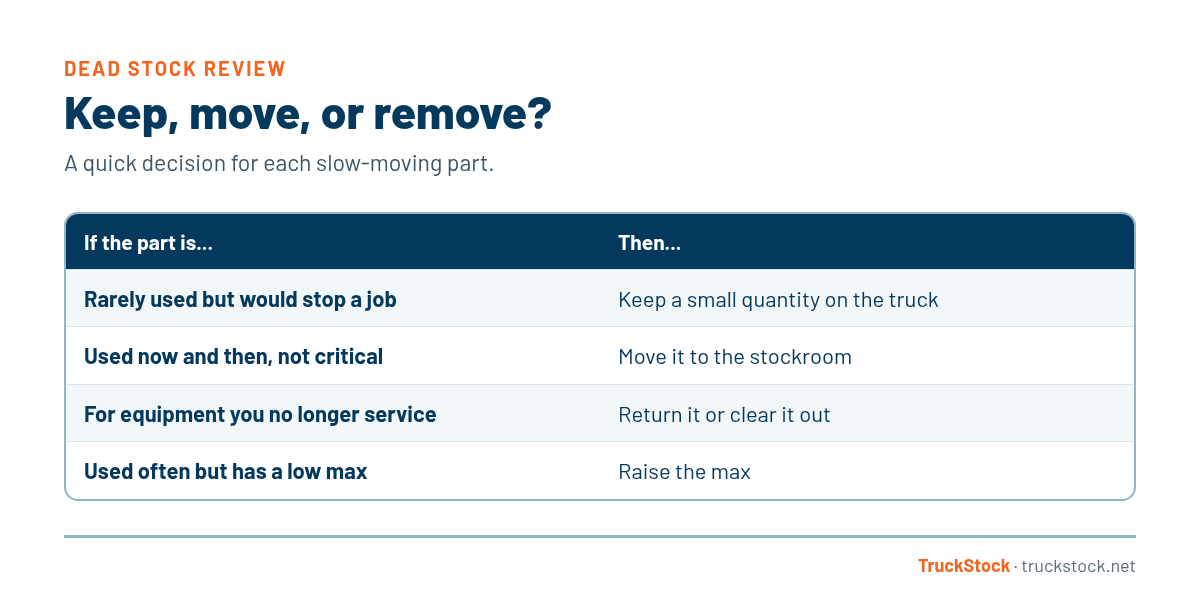
3. Move parts to the stockroom
Parts that are occasionally needed but not critical can live in the stockroom, where one unit covers the whole fleet instead of one per truck. That frees up space on every truck at once.
4. Return or sell off what you can
Some suppliers accept returns of unused stock, sometimes with a restocking fee. Ask. For parts you no longer use at all, returning them now is better than keeping them forever.
5. Update max levels
This is the step that keeps dead stock from coming back. Lower the max, or set it to zero, on the truck type so restocks don’t put the part right back. Here’s how to set min and max levels.
6. Repeat twice a year
Dead stock builds up slowly. A review every six months keeps it under control without becoming a big project.
A Quick Example
Say every service truck carries two of a motor that’s only been used once in six months across the whole fleet. Keeping two on each of ten trucks means twenty motors riding around. Moving them to the stockroom, keeping two there, and setting the truck max to zero frees up space on every truck. When the next call needs one, it’s a quick stockroom pull instead of a part no one can find.
The same review often turns up the opposite problem too: a part that gets used every week but has a max of one. Fixing both at the same time is what makes a mid-year review so worthwhile.
Common Mistakes
- Removing must-carry parts just because they’re rarely used.
- Clearing dead stock without changing max levels, so it comes right back.
- Keeping parts from equipment you no longer service.
- Never asking suppliers about returns.
- Reviewing once and never again.
How TruckStock Handles It
- Usage by part and truck. The Items Requested report shows what’s been used over any date range, grouped by part or truck, and downloads to Excel.
- Available Stock report. See every part on a truck against its max to spot parts that just sit.
- Max levels by truck type. Lower or zero out a part’s max and every truck of that type follows.
- Stockrooms. Keep slow movers in a stockroom, with its own counts, so they’re still available when needed.
Key Takeaways
- Use six months of usage to find dead stock.
- Keep must-carry parts, even if they’re rarely used.
- Move occasional parts to the stockroom.
- Return or clear parts you no longer need.
- Update max levels so dead stock doesn’t come back.
Frequently Asked Questions
What counts as dead stock on a service truck?
Parts that haven’t been used in several months and aren’t needed as must-carry parts. The exact window depends on your work, but six months is a good starting point.
Should I remove rarely used parts from every truck?
Not always. If a part is rarely used but would stop a job if missing, keep a small quantity. Otherwise, move it to the stockroom.
Can I return unused parts to suppliers?
Many suppliers accept returns of unused stock, often within a time limit or with a restocking fee. Check with each supplier.
How often should I review truck stock for dead stock?
Twice a year works well for most fleets, with a quick check whenever you change the kind of work a truck does.
Want to find the parts that never move? Start a free TruckStock trial and try the reports with sample data, or contact our team.
Recent Comments