
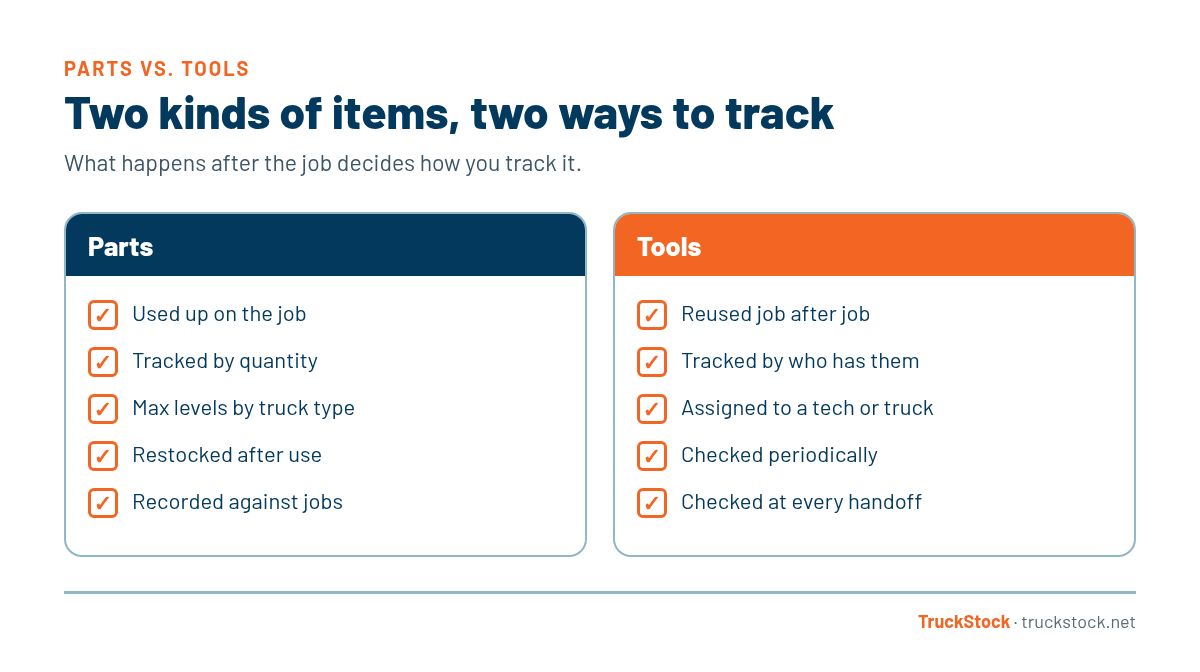
Tools and parts should be tracked differently. Parts get used up on jobs, so they’re tracked by quantity and restocked to max levels. Tools are reused, so they’re assigned to a tech or truck and checked periodically. Mixing the two in one list makes both harder to manage.
It’s a question that comes up a lot when companies start organizing their trucks. A truck carries both, and both cost money, so it seems natural to track them together. But they behave differently. A capacitor gets installed and replaced. A meter goes from job to job for years. Treating a meter like a part, or a part like a tool, creates confusion. Our post on tracking consumables and small parts covers the other end of the spectrum.
Parts vs. Tools at a Glance
How to Handle Each, Step by Step
1. Sort your list
Go through what your trucks carry and sort each item: does it get used up on a job, or does it come back? Anything used up is a part. Anything reused is a tool. A few items, like drill bits or blades, wear out over time. Treat those as parts if you replace them regularly.
2. Track parts by quantity
Parts belong on the truck’s stock list with max levels. When they’re used, they’re recorded and restocked. Here’s how to set min and max levels.
3. Assign tools to a person or truck
Tools are best tracked by who has them. Keep a simple list of which tools are assigned to which tech or truck, especially for expensive or specialized ones.
4. Check tools periodically
A quick tool check every quarter, or at every truck handoff, catches missing or broken tools before they cause a problem on a job.
5. Keep shared tools in one place
Specialized tools that only some jobs need can live at the shop and be signed out. That way you don’t need one on every truck.
Why Mixing Them Causes Problems
When tools sit on the same list as parts, they get max levels that don’t make sense and show up in restock requests by mistake. Usage reports get muddied, because a tool “used” on a job didn’t actually get consumed. And the list gets longer, which makes it harder for techs to find the parts they need.
Separating them keeps each list simple. The parts list drives restocking and job costs. The tool list answers one question: who has what? Both are easier to keep accurate when they’re not mixed together.
A Quick Example
Picture a company that put meters, gauges, and drills on the same list as fittings and capacitors. Restock requests sometimes included tools that weren’t missing, and reports showed tools as “used” on jobs. They moved tools to a separate assignment list by tech, kept parts on the truck stock list, and added a tool check to their truck handoff checklist. Restocking got simpler, and lost tools got noticed sooner.
Common Mistakes
- Giving tools max levels like parts.
- Restocking tools automatically when they’re not used up.
- Never checking which tech has which tool.
- Keeping specialized tools on every truck when a shared one would do.
- Forgetting to check tools at handoffs.
Where Consumables Fit
Some items sit in between. Tape, wire nuts, fasteners, and sealants get used up, but in small amounts that are hard to count one by one. Treat them as parts, but track them by the box or roll rather than the piece, and restock when a box runs low. That keeps them on the restock list without turning every job into a counting exercise.
How TruckStock Handles It
- Built for parts and materials. TruckStock tracks the parts and supplies that get used and restocked, with max levels by truck type.
- Clean restocking. Keeping tools off the parts list keeps requests and fulfillment focused on what’s really used.
- Usage reports that mean something. Reports show parts used by job, truck, or department, without tools muddying the numbers.
- Responsible person per truck. Each truck has an owner, which is also a natural person to check tools with.
Key Takeaways
- Parts are used up; tools come back.
- Track parts by quantity and max levels.
- Track tools by who has them.
- Check tools periodically and at handoffs.
- Keep the two lists separate.
Frequently Asked Questions
Are drill bits and blades parts or tools?
If you replace them regularly, treat them as parts so they get restocked. If they last a long time, treat them as tools.
Do I need to track every hand tool?
Usually not. Focus on expensive, specialized, or frequently lost tools. Basic hand tools can be part of a standard tech kit.
Who is responsible for tools on a truck?
The tech assigned to the truck is the natural owner. Check tools whenever the truck changes hands.
Can tools and parts share the same storage on the truck?
Yes. The difference is in how you track them, not where they sit.
Want parts tracking that stays focused? Start a free TruckStock trial or contact our team.
Recent Comments