

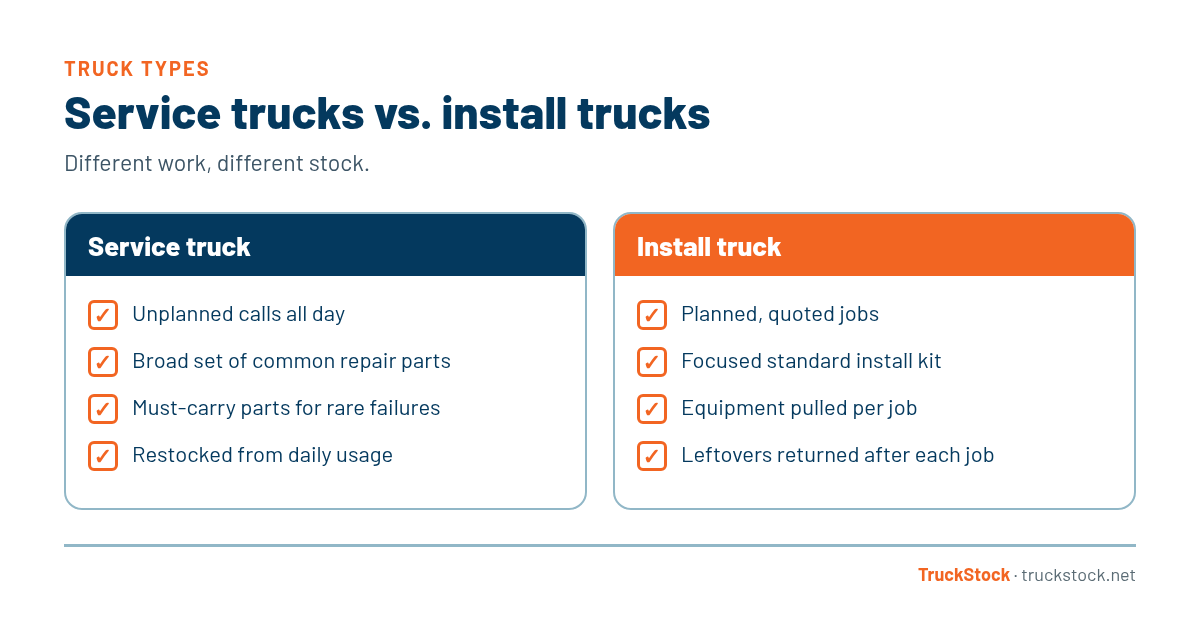
Install trucks should be stocked differently from service trucks. Service trucks carry a broad set of common parts because their calls are unplanned. Install trucks carry a smaller standard kit of fittings, fasteners, and supplies, and get the major equipment and job-specific materials pulled for each planned job.
It’s tempting to give every truck the same list, and for trucks doing the same work, that’s the right call. But install work and service work are different. A service tech doesn’t know what tomorrow’s calls will need. An install crew usually does, because the job was quoted and planned. Stocking them the same way either overloads install trucks or leaves service trucks short. Our post on multiple truck types covers the bigger picture.
Service Trucks vs. Install Trucks
How to Stock Each Type, Step by Step
1. Create separate truck types
Set up one truck type for service and another for install, even if they’re the same make of vehicle. Each gets its own parts list and max levels. If you have several trades, you might end up with HVAC service, HVAC install, plumbing service, and so on.
2. Build the service list from common calls
Service trucks should carry what common repair calls need, plus a few must-carry parts. That list comes from your job history. Here’s how much inventory a service truck should carry.
3. Build a standard install kit
Install trucks still need a base kit: the fittings, fasteners, sealants, and small parts nearly every install uses. Keep it focused. If an item is only needed for some installs, it belongs in the job pull, not on the truck.
4. Pull job materials for each install
For each planned job, pull the equipment and job-specific materials from the stockroom and stage them before the crew leaves. Record them against the job number so costs stay accurate. Our post on tying parts used to specific jobs explains why that matters.
5. Return leftovers promptly
Installs often leave extra material. Bring it back, record it, and return it to stock rather than letting it ride around. Here’s how to handle returns.
A Quick Example
Picture an HVAC company with four service vans and two install trucks. The service vans carry capacitors, contactors, motors, and filters for the calls of the day. The install trucks carry a focused kit of line set fittings, fasteners, pads, and sealants, and the equipment and line sets for each job are staged the afternoon before. Each truck type has its own list, so restocking is predictable for both.
The install crews also stop borrowing service parts “just in case,” because their kit covers what installs really need, and the service vans stay stocked for the calls they were built for.
Common Mistakes
- Giving install and service trucks the same parts list.
- Loading install trucks with major equipment “just in case.”
- Not recording job materials against the job number.
- Letting install leftovers ride around for weeks.
- Install crews borrowing from service trucks to cover gaps.
Why the Difference Matters
When install trucks carry a service-style list, they end up hauling parts they rarely touch, and the crew loses room for the materials an install really needs. When service trucks are stocked like install trucks, techs run short on the common repair parts that unplanned calls depend on. Either way, someone makes an extra trip.
Separate truck types also make restocking simpler. The stockroom knows that service trucks get refilled from daily usage, while install trucks mostly get job pulls plus a small top-up of the standard kit. That clarity helps the person running the stockroom plan their day.
How TruckStock Handles It
- Separate truck types. Create service and install truck types, each with its own parts list and max levels.
- Change a truck’s type. If a truck moves from service to install, TruckStock asks whether to empty it or request stock for the new type.
- Job numbers on requests. Record install materials against the job they were used on.
- Stockroom fulfillment. Pull job materials from the stockroom, with checks so you never send more than is on hand.
Key Takeaways
- Service and install trucks need different truck types.
- Service trucks carry broad stock for unplanned calls.
- Install trucks carry a focused standard kit.
- Pull job-specific materials for each planned install.
- Record install materials by job and return leftovers.
Frequently Asked Questions
Should install trucks carry any repair parts?
A few common ones can help if installers sometimes handle small service issues. Keep it limited so the install kit stays focused.
How do I handle trucks that do both service and installs?
Pick the type that matches most of the truck’s work, and pull extra materials for the other kind of job as needed. If the split is even, a combined truck type with a carefully chosen list can work.
Where should install equipment be stored before a job?
In the stockroom or a staging area, tagged with the job, until the crew loads it.
Do install materials need to be tracked if they’re billed to the job anyway?
Yes. Tracking keeps your stockroom counts right and makes sure everything used actually lands on the invoice.
Want to set up service and install truck types? Start a free TruckStock trial or contact our team.
Recent Comments