
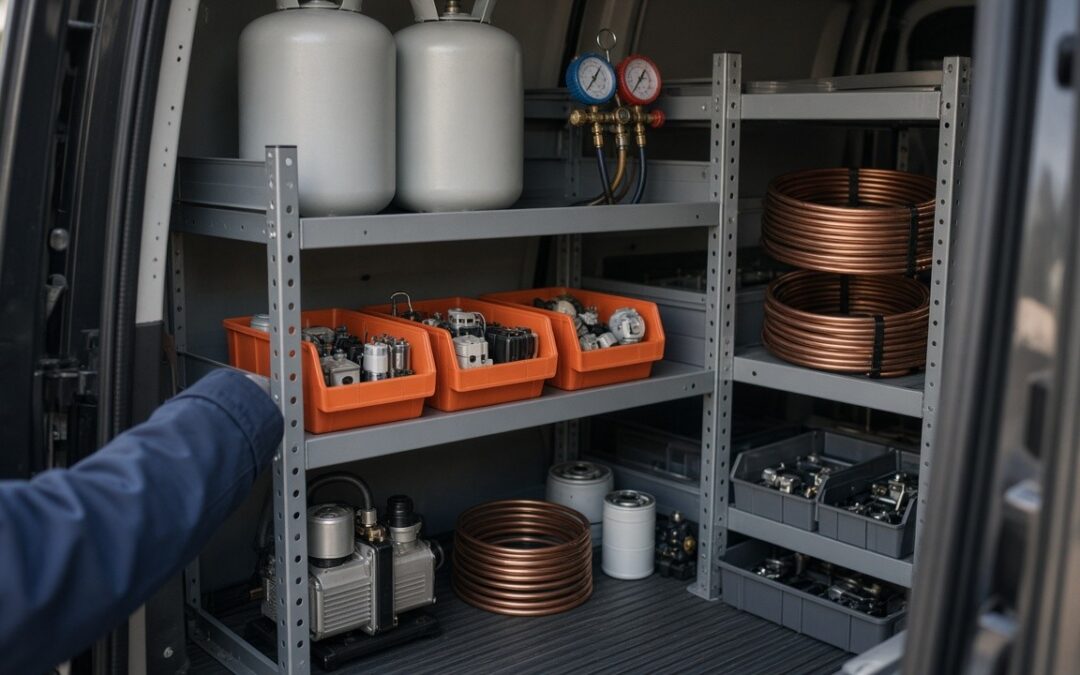
An HVAC service truck should carry the electrical components, motors, refrigerant supplies, filters, controls, and consumables that your most common repair calls need, plus a few must-carry parts that stop a job if missing. Start from a category list, then tune quantities to your calls and adjust them for heating and cooling seasons.
Every HVAC company stocks a little differently, depending on the equipment brands in its area and whether it focuses on residential or commercial work. But the categories are nearly universal. We’ve covered seasonal stock in what to carry for spring maintenance and planning for the summer rush. This post is the year-round baseline those build on.
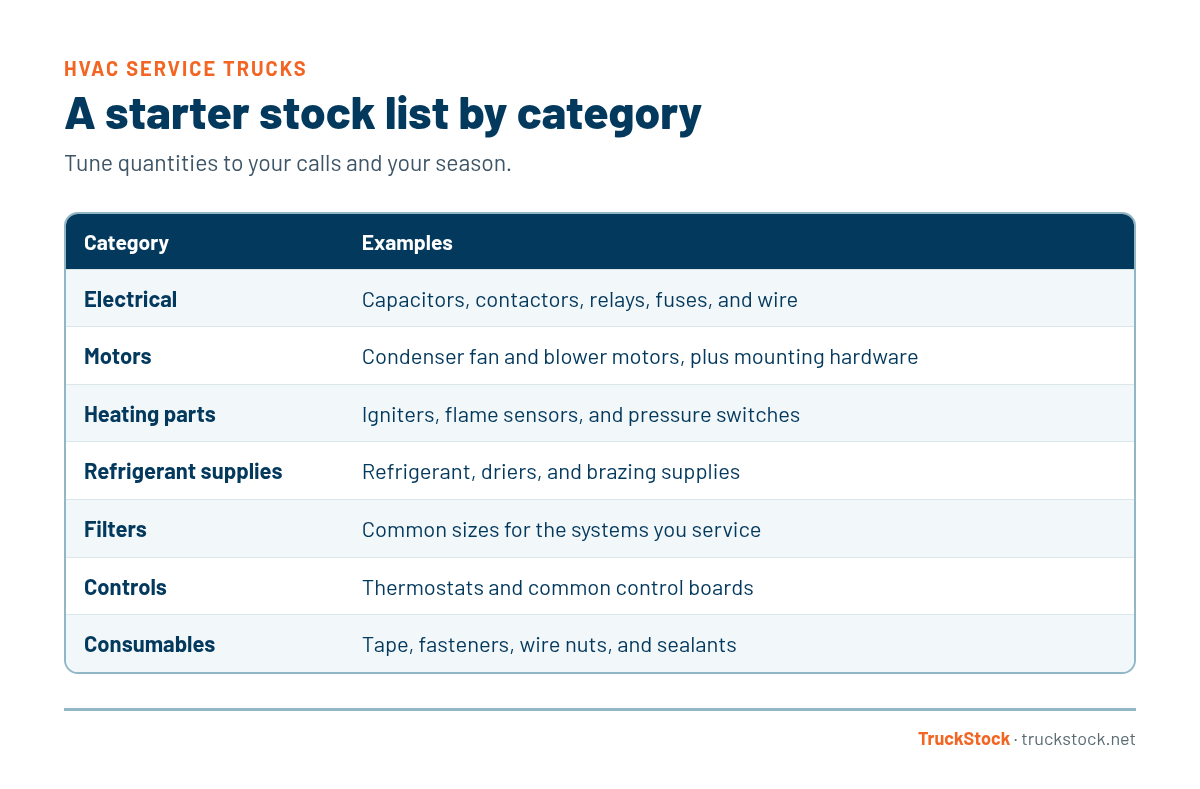
A Starter Stock List by Category
How to Tune the List to Your Calls
1. Look at your most common repairs
Pull a few months of service calls and note the parts used. Capacitors, contactors, and motors tend to show up often, but your history is the real guide.
2. Cover the equipment you see most
Universal parts cover a lot of ground, but some brand-specific parts are worth carrying if a brand is common in your area. Keep those limited to the ones your techs actually use.
3. Adjust by season
Cooling season leans on capacitors, contactors, condenser fan motors, and refrigerant. Heating season leans on igniters, flame sensors, and inducer parts. Raise and lower max levels as seasons change. Our post on seasonal truck stock explains the approach.
4. Add must-carry parts
Some parts are rarely needed but would end the visit without them. Keep a small quantity of each, even if usage looks low.
5. Set max levels and review
Set max levels for each part, and review usage every few months. Here’s how to set min and max levels.
Why a Standard List Helps
When every HVAC service truck starts from the same list, restocking gets predictable, techs can cover for each other, and you can see which parts really drive your work. It also makes it easier to plan stockroom inventory before busy seasons, because you know what every truck should carry.
Without a list, trucks drift. One tech carries three of everything, another carries almost nothing, and the stockroom never knows what to expect. A shared list fixes that without taking away a tech’s ability to request what they need.
A Quick Example
Picture a residential HVAC company setting up a service truck type for the first time. The service manager builds the list by category, gives capacitors and contactors higher max levels for summer, and adds a few must-carry parts with a max of one. In the fall, the maxes on cooling parts come down and heating parts go up. The trucks don’t change, but the list does, and every truck of that type follows.
Common Mistakes
- Carrying brand-specific parts for equipment your techs rarely see.
- Keeping summer max levels all year.
- Skipping must-carry parts because they’re rarely used.
- Letting each truck build its own list.
- Forgetting consumables like tape, fasteners, and wire nuts.
Keeping the List Current
Equipment changes over time. New systems come into your area, older ones get replaced, and the parts your techs need shift with them. A list that was perfect three years ago may be carrying parts for equipment you rarely see anymore.
A good habit is to ask techs once a season what they wished they’d had on the truck, and to compare that with what usage shows. Techs often spot new needs before the numbers do, and usage shows what’s quietly stopped moving. Together they keep the list honest.
How TruckStock Handles It
- Truck types with max levels. Set up an HVAC service truck type with its parts list and max levels, shared by every truck of that type.
- Seasonal changes in one place. Adjust max levels on the truck type when seasons change, and every truck follows.
- Try it with sample HVAC data. The free trial comes loaded with sample HVAC trucks and parts so you can see how it works.
- Usage reports. See what each truck used over any date range, grouped by part or truck.
Key Takeaways
- Start from a category list and tune it to your calls.
- Cover the equipment you see most.
- Adjust max levels for heating and cooling seasons.
- Keep a few must-carry parts.
- Use one standard list per truck type and review it regularly.
Frequently Asked Questions
What are the most important parts for an HVAC truck?
The parts your most common repairs use. For many companies, that includes capacitors, contactors, motors, igniters, flame sensors, filters, and refrigerant supplies.
Should HVAC trucks carry brand-specific parts?
Only for brands that are common in your area and parts your techs actually use. Universal parts cover most needs.
How should HVAC truck stock change by season?
Raise max levels on cooling parts before summer and heating parts before winter, and lower them as each season ends.
Should install trucks use the same list?
No. Install trucks usually carry a focused install kit and get equipment pulled for each job.
Want to see an HVAC truck list in action? Start a free TruckStock trial with sample HVAC data, or contact our team.
Recent Comments